

Your Brain Can Learn to Regulate Itself. That’s What Neurofeedback Does.
Introducing a new tool at Swift Mind Care — and why I decided to add it.

Personal Note: Neurodivergent individuals often benefit from clear and visual information. This data provides a more objective perspective, which can be particularly helpful for those who may not readily perceive changes or require external validation.
You’ve probably heard thAe word neurofeedback at some point. Maybe from a podcast, maybe from a friend whose kid did it for ADHD, maybe from a corner of the internet that made it sound either like a miracle or complete pseudoscience.
Neither of those is accurate.
Neurofeedback is a legitimate, research-backed clinical tool. It’s been used in psychiatry, neurology, and psychology for decades. The American Academy of Pediatrics has rated it as a Level 1 “Best Support” intervention for ADHD — the same category as medication. The U.S. military uses it for PTSD. Athletes use it for performance. And increasingly, neurodivergent people are using it to help their nervous systems do what medication and therapy alone sometimes can’t quite reach.
Starting June 2026, Swift Mind Care is offering neurofeedback as a structured 3-6 month packaged service. I wanted to write this before the launch to explain what it is, what it isn’t, and why it belongs here.
What’s Actually Happening in Your Brain
Every thought, feeling, and behavior you have is the result of electrical activity in your brain. Different types of brainwaves correspond to different states — focused, calm, anxious, drowsy, alert.
In ADHD, there’s typically too much slow-wave activity (theta) and not enough fast-wave activity (beta) in the frontal regions. That’s not a character flaw or a lack of effort. It’s the brain’s default pattern. And because the brain runs on patterns, the same neural pathways fire over and over — which is why ADHD can feel like being stuck, no matter how hard you try to push through.
In anxiety, the pattern looks different — usually too much high-frequency activity in the right hemisphere, which keeps the nervous system locked in a low-grade threat state. In PTSD, the amygdala is overreactive and the prefrontal cortex, which is supposed to regulate it, isn’t doing enough of that job.
These are trainable patterns. That’s the core premise of neurofeedback.
How It Works
During a neurofeedback session, small sensors sit on your scalp and read your brain’s electrical activity in real time. Nothing goes in. No electrical current, no stimulation. Just listening.
That data is fed into software that responds to your brainwaves moment by moment. When your brain moves toward a more regulated pattern, you get a reward signal — usually something visual or auditory, like a movie playing smoothly or a tone. When your brain drifts toward the less helpful pattern, the signal pauses.
Your brain notices. And gradually, it learns.
It’s the same mechanism behind every kind of learning. Feedback, repetition, adjustment. The difference is that here, the feedback is happening at the level of your nervous system directly — not through insight, not through willpower, not through trying harder.
Most people do 20 to 40 sessions over a few months. Results tend to build gradually, though many people notice something shifting — sleep, focus, reactivity — within the first few weeks.
Who This Is For
The research covers a lot of ground. But the people who tend to benefit most from neurofeedback are the same people who end up at a practice like Swift Mind Care.
ADHD. This is where the evidence is strongest. Neurofeedback consistently improves attention, impulse control, and follow-through — not by forcing the brain to work harder, but by training it to hold a more efficient pattern on its own. For people who don’t tolerate medication well, or who want to build skills that last after treatment ends, this is worth understanding.
Autism. Neurofeedback doesn’t try to change who you are. What it targets is the regulatory layer — sensory overwhelm, emotional dysregulation, the exhaustion of a nervous system that never quite gets to rest. Gains tend to be slower here, but they’re real, and they compound.
PTSD and trauma. A traumatized nervous system is one that got stuck in protection mode. It’s not broken — it learned to survive. But those same survival patterns become costly when the threat is gone and the brain keeps running the alarm anyway. Neurofeedback works alongside therapy to settle the nervous system from the bottom up, so the therapeutic work has somewhere to land.
Anxiety. Neurofeedback is particularly effective for people whose anxiety lives in the body — the hypervigilance, the physical tension, the sense that your nervous system is running too fast and you can’t find the brake. It helps the brain learn what downshift actually feels like.
Memory, aging, and cognitive changes. Brain function naturally shifts over time, and for people who’ve been on medications that affect cognition, or who are dealing with post-COVID symptoms, or who simply want to maintain sharpness — neurofeedback has a place here too.
What Makes This Different from Other Tools
Therapy works with your thoughts, your narrative, your patterns of relating. Medication adjusts the neurochemical environment. Both are valuable. Both have limits.
Neurofeedback works at a different level. It doesn’t ask you to talk about something. It doesn’t require insight or self-awareness in the moment. It just trains the brain directly — the way physical therapy trains a muscle, or the way practicing an instrument trains the motor system.
For a lot of neurodivergent people, that distinction matters. Insight doesn’t always translate into regulation. Knowing why you’re overwhelmed doesn’t always make you less overwhelmed. Neurofeedback addresses the underlying pattern rather than the symptoms that come from it.
It’s not a replacement for therapy. I want to say that clearly. The combination of both tends to produce the best outcomes — therapy working the meaning and neurofeedback working the nervous system. They move in the same direction.
How We’re Doing This at Swift Mind Care
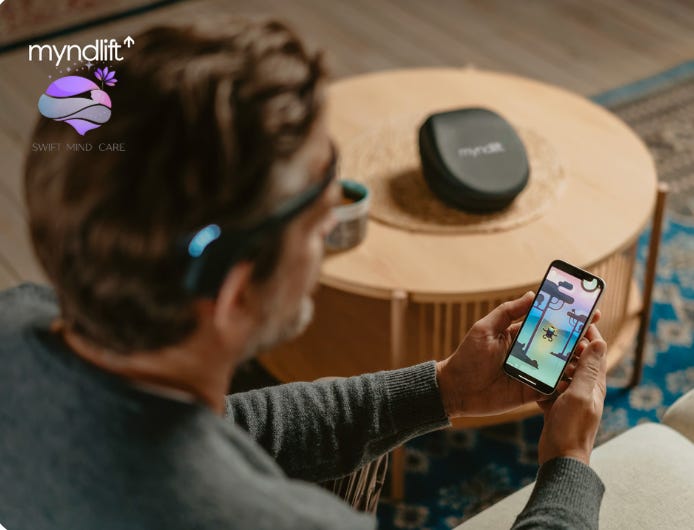
We’re using a platform called Myndlift, which is designed specifically for clinician-supervised home neurofeedback. Most clients will rent a headset and train at home several times a week using the app. I monitor your sessions remotely, adjust your protocol as needed, and we meet monthly to review your progress.
Every client starts with an assessment — a full clinical intake and a brain map (qEEG) that shows us what your brain is actually doing. We use that to build a training protocol specific to you. Not a template. Not a one-size-fits-all approach.
The full series is three months. That includes the initial assessment, monthly clinical reviews, and an end-of-series session where we look at outcomes and decide next steps together.
I’m accepting a small initial cohort in June. If you’ve been curious about this for yourself or someone in your family, now is a good time to reach out.
The Honest Part
I didn’t add this to my practice because it was trendy. I added it because I kept running into the same ceiling in treatment — clients who were doing the work, showing up to therapy, trying everything — and still couldn’t access the regulation they needed. Something was keeping the system stuck.
Neurofeedback addresses that directly. It’s not magic, and I won’t present it that way. Some people respond quickly. Some take longer. A few don’t respond well, and need a lot of support. We track progress, adjust protocols, and stay honest about what’s happening.
What I can say is this: for the right person, this tool does something that other approaches don’t quite reach. It changes the pattern at the source. And for a brain that has been working hard for a very long time just to function — that can be a significant thing.
If you want to learn more about the service, visit swiftmind.care/neurofeedback. If you’re ready to talk about whether this is a fit for you, you can reach out through the contact form there.
Your brain has been doing its best with the patterns it has. Maybe it’s time to give it some new ones.
Rachelle Pavao Goldenberg, LCSW Swift Mind Care · Danville, CA Neuroaffirming Therapy for Neurodivergent Adults