

Same Room, Different Training
How Social Workers, MFTs, and Psychologists Approach Mental Health

I’m often asked why I practice the way I do, and those outside my field sometimes wonder why I explore certain topics so deeply with clients. My approach is distinct, and I believe it aligns beautifully with neuroaffirming care thanks to the strong foundation in a Social Worker’s training. Many people assume all therapists are essentially the same—same couch, same questions, same process—and that the letters after a name are merely a formality. They’re not. Each credential profoundly shapes how a clinician thinks, what they observe, and how they approach their work. No discipline is inherently better than another, but they are genuinely different, and recognizing those differences can empower you to make a more informed decision about your care. This is precisely why I wrote this article—to help you clarify what you’re looking for and provide an honest, straightforward comparison.
A Quick Look at the Three Most Common Credentials
LCSW — Licensed Clinical Social Worker Masters-level training in both clinical practice and systems. Trained to see the individual within the context of family, community, culture, and policy. Scope includes therapy, assessment, diagnosis, case management, advocacy, and systems navigation.
MFT — Marriage and Family Therapist Masters-level training with a primary focus on relational systems — couples, families, and how individuals function within those relationships. Rooted in systems theory and communication patterns.
Psychologist (PhD or PsyD) Doctoral-level training with deep focus on psychological theory, research, and assessment. In most states, psychologists do not prescribe medication but are uniquely qualified to conduct psychological testing and neuropsychological evaluations.
Where the Training Diverges
This is where it gets meaningful.

The Social Worker: Person in Environment
An MSW is trained to hold the individual and the world around them at the same time. The question is never just “what’s happening inside this person” — it’s “what is this person navigating, and how is their environment contributing to or compounding their experience?”
That means poverty, systemic racism, lack of access to resources, housing instability, workplace discrimination, and cultural identity aren’t background information. They’re clinical information.
Social workers are also trained explicitly in resource navigation, policy literacy, and advocacy. When a client can’t access care, can’t get accommodations at work, or is caught in a system that keeps failing them — a social worker has the training to engage that directly, not just process the feelings around it.
The ecosystem is always part of the assessment.

The MFT: Relationships as the Unit of Treatment
MFTs are trained to see the relationship as the primary unit of focus — even when working with one person in the room. Their lens is relational and systemic in the interpersonal sense: how do patterns form between people, how does communication break down, how do family structures perpetuate certain dynamics?
This makes MFTs exceptionally well-suited for couples work, family therapy, and exploring how relational history shows up in present behavior. The training runs deep in attachment, communication theory, and how individuals are shaped by the systems closest to them — their family of origin, their partnerships, their immediate relational world.
Where an MFT’s training can be narrower is in the macro layer. Policy, community systems, and structural barriers are less central to the MFT curriculum. The focus stays closer to home — literally.

The Psychologist: Assessment, Research, and Depth of Theory
Psychologists bring something the other two credentials don’t — doctoral-level depth in psychological theory and, critically, the ability to conduct formal psychological and neuropsychological testing. If someone needs a comprehensive evaluation for Autism, ADHD, a learning disability, or a complex diagnostic picture, a psychologist is typically the right person for that assessment.
Their research training also means many psychologists have deep expertise in specific evidence-based modalities. They’ve often spent years studying one population or treatment approach at a level that goes beyond what a master’s program covers.
Where the doctoral model can sometimes fall short is in the practical, on-the-ground work of systems navigation. The training is rich in theory and assessment but doesn’t necessarily prepare someone to help a client fight for a school accommodation, find sliding-scale housing resources, or understand how a lifetime of systemic marginalization has shaped someone’s mental health. That’s not a weakness in the discipline — it’s just not the focus.
A Side-by-Side Look
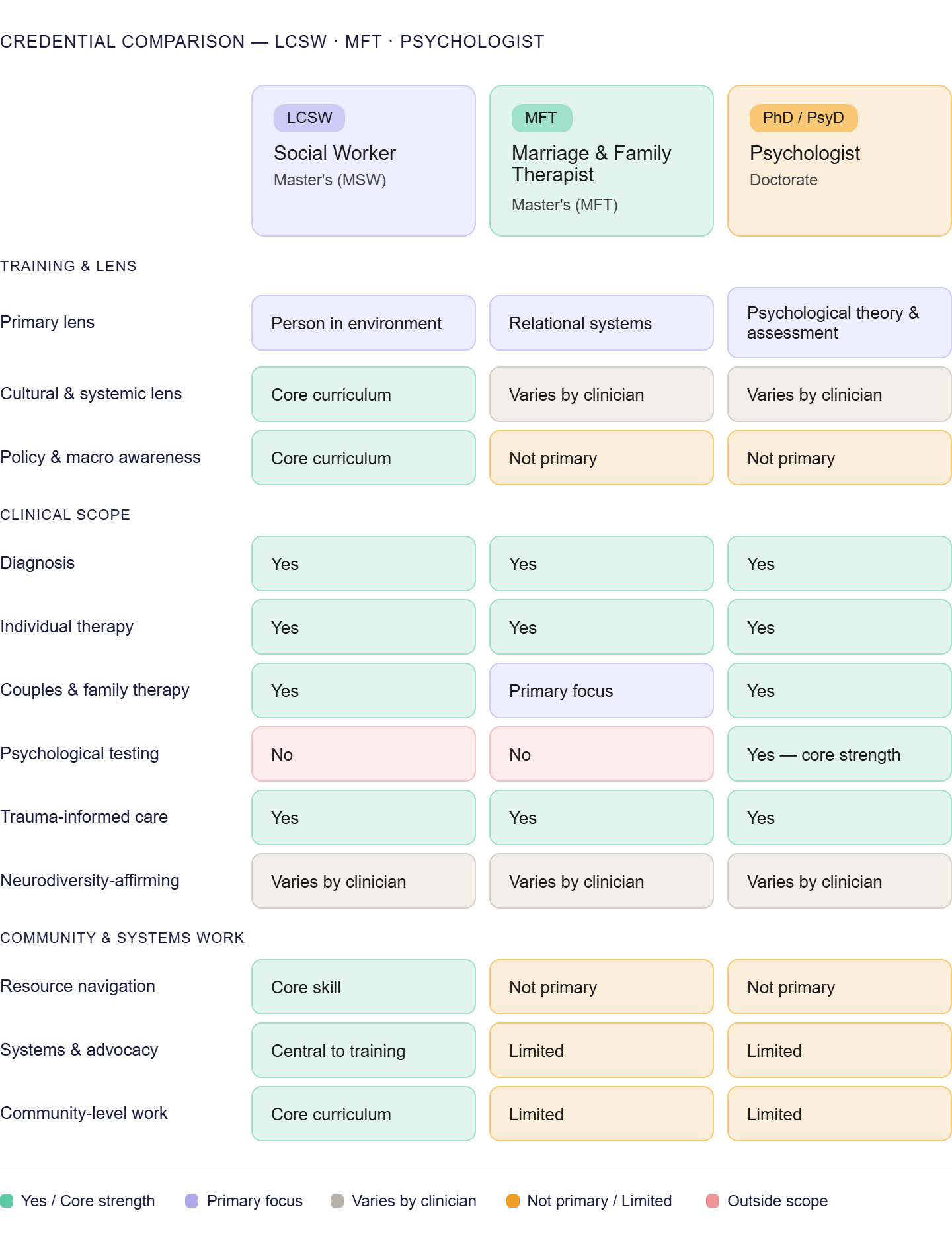
What This Means in Practice
If you’re working through relationship patterns, communication breakdowns, or family dynamics — an MFT’s training is purpose-built for that.
If you need comprehensive psychological testing, a formal evaluation, or deep theoretical work in a specific evidence-based model — a psychologist brings something distinct.
If you’re carrying the weight of your own psychology and the weight of the world around you — the systems that have shaped you, the resources you’ve been denied, the judgments you’ve absorbed, the environments that have never quite fit — a social worker is trained to hold all of that at once.
These aren’t mutually exclusive. Many people benefit from more than one provider across a lifetime. And within each discipline, there’s enormous variation in how clinicians actually practice.
The credential is the starting point. The clinician is what matters most.
A Note on Overlap
It’s worth saying clearly: skilled clinicians across all three disciplines can and do excellent work. A talented MFT can hold cultural context beautifully. A psychologist can be a masterful trauma therapist. An LCSW can develop deep expertise in assessment.
Training shapes the foundation. Experience, supervision, ongoing education, and the clinician’s own self-awareness build on top of it.
What I’m describing here are the structural differences in how each discipline is trained — not a ranking of who does better work. The differences matter for fit. They don’t determine quality.
Why I Bring This Up
I share this not to position one credential above another, but because I think people deserve to understand what they’re actually getting when they walk into a therapy room.

When I work with someone, I’m drawing on a framework that was explicitly designed to see beyond the individual — to ask what systems have shaped this person, what resources they need, what judgments they’ve had to carry, and what it would take to build a life that actually fits who they are. I consider the Macro (the environment, systems, and policies around them), the Mezzo (their workplace or family), and the Micro (their personal world and neurology).
That’s the social work lens. And for a lot of people — especially those who have felt unseen, misdiagnosed, or failed by systems — it’s the one that finally makes things click.
Rachelle P. Goldenberg, LCSW is a neuroaffirming therapist, consultant, and educator with over 17 years of experience supporting neurodivergent, LGBTQ+, and culturally diverse individuals. She is the founder of Swift Mind Care, based in California.